TWO:But long before this¡ªas early, indeed, as the 15th of April¡ªnews had reached London of the death of the erratic Emperor Paul, and of the bombardment of Copenhagen by the British fleet. Paul had been won over by Buonaparte to his views, and had been flattered by him by being elected¡ªthough irregularly and illegally¡ªGrand-Master of the Knights of Malta. He had been persuaded that the conquest of Malta by the British was an invasion of his rights, and by these and other flatteries Buonaparte had influenced his weak mind to become the agent of his plans in destroying the British ships in the Baltic, and in closing that sea to British commerce. Paul pretended that we had captured Danish convoys, these same convoys being engaged in guarding vessels loaded with materials of war for France, and that thus the independence of the North was menaced by us. On this ground, and on that of the invasion of Malta, he immediately laid an embargo on all British vessels in Russian ports, and as two vessels in the harbour of Narva resisted the attempts to seize them, in consequence of the embargo, he ordered all the British vessels in that port to be burned. In consequence of this sudden and unwarrantable order, contrary to all the laws of nations, about three hundred British vessels were seized, and the officers and crews dragged on shore, put into irons, and sent up the country under menaces of Siberia. Paul next ordered all property of Englishmen in Russia to be seized and sold. Denmark¡ªwith whom we had various rencontres, on account of its men-of-war convoying vessels laden with stores for French ports¡ªsoon joined Russia. We sent Lord Whitworth to Copenhagen to endeavour to come to some understanding on these matters in 1800, but though a convention was signed, it was not satisfactory. Sweden followed the example of Denmark, and the three Northern Powers entered into a treaty of armed neutrality to resist our search of their vessels in any circumstances. As the consequence of this policy would be to shut us out of all trade with the ports of the Baltic, it was resolved to send a fleet to chastise these Powers and break up their co-operation with France. Mr. Vansittart was despatched to Copenhagen, accompanied by a fleet of eighteen sail of the line, with several frigates and smaller vessels, under command of Admiral Sir Hyde Parker, with Vice-Admiral Nelson as second. The fleet left the Yarmouth Roads on the 12th of March, 1801, and arriving at the mouth of the Sound, Nelson recommended that they should sail directly up to Copenhagen, and be prepared, on the refusal of our proposals, to bombard the place, as this would not allow them time to get ready their batteries, and thus do all the more damage to our ships and men. But this was deemed too offensive before any attempt at negotiation, and accordingly Mr. Vansittart was sent forward in a frigate with a flag of truce, leaving the fleet at the Scaw. He returned without effecting anything more than what Nelson anticipated. Sir Hyde Parker wasted time in making[481] the needless inquiry by a flag of truce of the Governor of Elsinore, whether the passage of the Sound would be disputed, who replied that it would. It was then proposed to enter by the Belt. Nelson said:¡ª"Let it be by the Sound, or the Belt, or anyhow¡ªonly don't let us lose an hour."
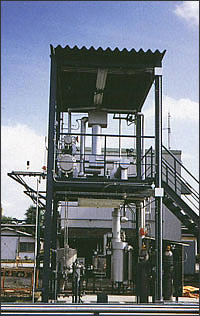
Great attention is recently being paid to global environmental issues, and it is now conceivable that companies will need to treat used solvents themselves. In consideration of this kind of social issue, we have developed a “membrane separation type solvent dehydration system,” which uses a polyimide membrane with superior dehydration properties developed by Ube Industries, Ltd. in combination with our own distillation and concentration technology that has resulted in solvents being more easily recovered.
THREE:On the 26th of August Massena arrived before Almeida, a strongly fortified town not thirty miles from Ciudad Rodrigo. Wellington hoped that it would detain him at least a month, for it had a good Portuguese garrison, commanded by Colonel Cox, an English officer: and he himself drew near, to be able to seize any opportunity of damaging the besiegers. But in the night of the 27th there was a terrible explosion of a powder magazine, which threw down part of the wall, and made the place untenable. Treachery was immediately suspected, and what followed was sufficient proof of it; for the Portuguese major, whom Colonel Cox sent to settle the terms of the capitulation, went over to the French, and was followed by a whole Portuguese regiment with the exception of its British officers. This was a great disappointment to Lord Wellington, whose plan was to detain Massena till the rainy season set in, when he would at once find himself embarrassed by bridgeless floods and in intolerable roads, and, as he hoped and had ordered, in a country without people and without provisions.
- 1Under the distillation system, even in case of azeotropic solvent compositions, this system which remove water vapor by the polyimide membrane will easily dehydrate.
- 2In comparison with the distillation system, it significantly saves on use of steam.
- 3Dehydration can be performed through merely supplying evaporated vapor to the membrane module and maintaining the differential pressure between the permeable side and the impermeable side.
- 4Solvent purity of 99.9% or more can be achieved by carrying out dehydration with a polyimide membrane only.
- 5The polyimide membrane has superior heat and solvent resistance. Therefore, the vapor permeation system reduces contamination of the membrane and thus extends its life.
THREE:The Ministers, instead of making rational concessions to the demands of the people for Reform, proceeded without delay to fresh aggressions on their liberties. Not contented with the existing suspension of the Habeas Corpus Act, and with introducing into the Lords a Bill for the protection of the king's person and Government, they passed a law prohibiting all political meetings, and another to extend the law of treason; they recommenced arrests and prosecutions, and sent out shoals of spies and informers, so that all the safeguards of public liberty were completely annihilated. These despotic measures did not pass without energetic opposition and a good deal of violent language from Fox; but all remonstrance was useless against Pitt's majority. Still the alarm of the Government was not allayed. On the 8th of December the king sent a message to both Houses, reiterating his assurance of an earnest desire to negotiate peace with France. The Opposition very properly pointed out that, so far as France was concerned, victorious in its armies, and as anti-monarchical in its government as ever, there were less hopes of any consent on its part to peace than when the Opposition had so repeatedly urged the same measure. In this unsatisfactory state closed the year 1795.The Parliamentary proceedings of 1839 were closed by an elaborate review of the Session by Lord Lyndhurst, which he continued annually for some time while the Liberals were in power. This display took place on the 24th of August, when the noble and learned lord moved for a return of all Bills that had arrived from the House of Commons since the commencement of the Session, with the dates at which they were brought up. He could point to the fact that Ministers had with difficulty carried a colourless Jamaica Bill, and had once more failed to pass the Irish Corporation Bill.
The aromatic polyimide membrane is highly permeable to water vapor but less permeable to vapors of organic compounds such as alcohol etc.
THREE:[See larger version]Walpole ridiculed the notion which had gone abroad that the revenue officers would be increased into quite a standing army, and would endanger the common liberty by their being empowered to enter private dwellings to search for concealed excisable articles. He said the increase would be only a hundred and twenty-six persons and that the Customs now possessed more searching power than he proposed to give to the Excise.
- 1 Recovery of the detergent solvent Recovery of the cleaning solvent such as electronic parts industry, precision instrument industry.
- 2Solvent recovery and the refinement Solvent recovery and the refinement such as chemical industry, an industry of medical supplies, food industry, the fermentation industry.
THREE:The next person to attempt the impossible in the vain endeavour to keep the vessel of the old French monarchy afloat with all its leaks and rottenness, was the Archbishop of Toulouse, Lom¨¦nie de Brienne. He had vigorously opposed Calonne; but there was no way of raising the necessary revenue but to adopt some of the very proposals of Calonne, and tax the privileged classes, or to attempt to draw something still from the exhausted people. As the less difficult experiment of the two, he was compelled to cast his eyes towards the property of the nobles and the Church; but he found the nobles and the clergy as ready to sacrifice him as they had been to sacrifice Calonne. When one or two of the more pliant or more enlightened members of those classes ventured to remark on the vast amount of untaxed property, and particularly of tithes, there was an actual tempest of fury raised. Tithes were declared to be the voluntary offerings of the piety of the faithful, and therefore not to be touched. As further loans were out of the question, some one ventured to assert that the only means of solving the difficulty was to assemble the States General. "You would convoke the States General?" said the Minister in consternation. "Yes," replied Lafayette, who was bent on revolutionising France, as he had helped to revolutionise America¡ª"yes, and something more than that!" These words were taken down as most exceptionable and dangerous. All that the Assembly of Notables could be brought to do was to confirm the abolition of the corv¨¦e, and to pass a stamp act. They would not move a step further, and they were dismissed by the king on the 25th of May, 1787. The Parliament, or Chief Court of Justice, adopted a similar course, and it also was dismissed. The king then promulgated a new constitution, but it fell hopelessly to the ground.CALVI, CORSICA.
Acetone, ethanol, methyl ethyl ketone, butanol, isopropyl alcohol, ethyl acetate, methyl isobutyl ketone, others (including hexane and toluene).
